Saturday, October 18, 2014

King Philip II aria from the opera Alexander the Great by Panos Karousos

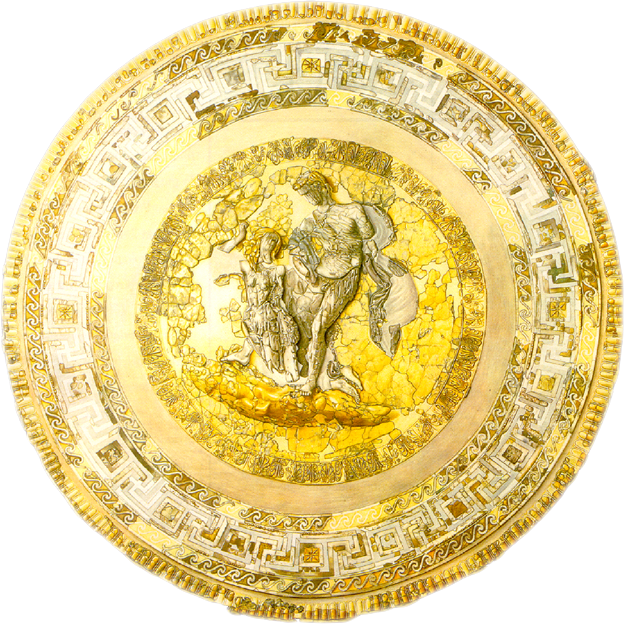
Philip II shield
ACT 1
Scene 2
Aegea, Macedon – Assassination of Philip II
 In the great amphitheater, Philip II is organizing the wedding of his daughter Cleopatra with her uncle King Alexander I of Molossis, a kingdom from Epirus to Italy.  Previously, Philip himself had married a fifth wife, Cleopatra Eurydice while his fourth wife, Olympias of Epirus, had withdrawn in Molossis with her brother Alexander I.  Philip II underestimated Olympias’ reaction to his marriage and her thirst for power and authority.

Macedonians: Long live the newlyweds, Cleopatra of Philip and Alexander I of Molossis.

Cleopatra of Philip and Alexander of Molossis: We thank you, people of Macedon; you are now connected again with Epirus and Molossis.

Macedonians: Long live our King Philip II; Grand General of all the Greeks.

Philip II: Macedonians, glorious people; Macedonians successors of Heracles, we stay here having the Dream of Anatolia in our hearts.  If you are united with me, I will lead you to the victorious fight of the Greeks.

Macedonians: Lead us Philip, against the Persians.

Philip II: The Great Idea, oh, noble friends.  Finally, all the Greeks, we are now united.  Thracians, Illyrians, Scythians, Persians, the Macedonians are conquering you.  Fellow Greeks, we will bring peace to all the Greek cities of Asia Minor.

Macedonians: We are all with you, Philip.

Pausanias of Orestis: We are all with you, Philip… (Stubs and kills Philip with a knife)

Philip II: Pausanias… Ah…

Macedonians: Misfortune… Death to the murderer of Philip II

(Perdikkas and the nobles kill Pausanias)

Alexander: Father…

Philip II: Ah… Alexander, my child, never harm anyone during your life otherwise harm will find you, my son.  The war in Asia I bestow to your capable hands.  Take the army and go away from your mother… Ah…

Macedonians: (they lament)

Panos Karousos: Alexander the Great (Aria of the Throne)

Alexander the Great painted by Apelles
(Aria of the Throne)
Alexander the Great
And when the entire world was stretched in front of me
Like a vast field full of flowers
When I looked life right in the eyes and won
And above everything I flew into the deep blue
And what lays beyond I am going to see, and beyond all that is beyond
And you God, I want to find you and look in your face I want
And then to return to you human I want, back to you
For you life I will return, for you I will return
And when we started singing my brothers
And our song united with that of the birds up high
Everything seemed right then immortal and victorious
Then, I threw the wreaths to your hands
And what lays beyond I am going to see, and beyond all that is beyond
And you God, I want to find you and look in your face I want
And then to return to you human I want, back to you
For you life I will return, for you I will return!
(From the opera Alexander the Great by Panos Karousos)

OLYMPIAS aria ACT I from the opera Alexander the Great by Panos Karousos

ACT 1
Scene 3
Pella, Macedon
 Olympias, whose name was originally Myrtale, was the Grand Priestess of the Shrine of Zeus at the oracle of Dodona.  While a priestess, she descended to the Necromanteion of Acheron, the oracle of the death, to speak with the dead, and received a prophesy and an order to devote herself to the Kabeiria Mysteries of Dionysus in Samothrace.  She went there, she became a priestess and it was there that she met Philip II who proposed to marry her.  She accepted the proposal with the condition that she would become Queen of Macedon and Philip’s official wife.  Queen Olympias had two children with Philip, Alexander and Cleopatra. Despite her new title, her previous title of Grand Priestess demanded respect and she was presiding over ceremonial sacrifices.

Macedonians: Olympias!

Olympias: Iacchus, is the altar ready?

Macedonians: It is ready and sanctified.  Come to the sacrificial ground Great Olympias.  Give the sacred goat as a sacrifice to Semele’s son.[1]  Great Priestess Olympias, make the sacrifice with the double axe.

Olympias: Glory to the Great Goddess!  Fire and blood! (Olympias sacrifices the goat)
Great Goddess, receive this Blood Bath!  Come, Fire from the sky, Prometheus’ Fire, cathartic fire of the Kabeiria Mysteries of Samothrace.

Macedonians: Olympias, like a dragon you are who chills my blood in horror.  Glory, glory to the Queen Olympias!

Olympias: Zeus and you ancient Kabeirians listen to my words.  Dionysus, help me take revenge in the name of the Macedonians, in the name of Philip and for my throne, and may the blood of my enemies spill as the blood of this goat.

Macedonians: Gods and you, Zeus, you threw your bolt of lightning in Olympias’ bowels.  She received the sperm of a god and you gave birth to a Prince son, the greatest son of Zeus!

Olympias: Macedonians, Greeks, I had wild and prophetic dreams.  While I was a priestess in Samothrace, the same night that took Philip as my husband, I dreamed a storm and a bold of lightning entered my body and exited as fire which grew larger and larger and then disappeared in the chaos.  That night, worshiping Orpheus!  So many good and horrible things happened that night.  Ah! News of three victories reached me the night that Alexander was born.

Macedonians: Worshiping Orpheus, in a trance, holding the thersus and a snake, you stormed first of the Mainades[2] with Bacchus at your side, in the mountains of Thrace!

Olympias: Macedonians, be quiet.  Be quiet, do not talk any more!  You betrayed me and then you betrayed me some more, so be quiet and stop talking.  Remember, that it was I who gave birth to Alexander the Great.  I learned the mysteries of the Egyptians and of Atlantis from Pharaoh Nectanebo I[3] and that’s my background and Alexander’s.

Macedonians: Glory to Great Olympias!  Glorious Olympias!

Olympias: Be quiet, didn’t you hear what I said?  Be quiet, Macedonians.


[1] Translator’s note: Semele was the mother of Dionysus by Zeus
[2] Translator’s note: Mainades were female deities participating in the mysteries of Dionysus, also called Bacchus and Iacchus.
[3] Translator’s note: Pharaoh Nectanebo I of the 30th Dynasty who was in contact with the Greeks while fighting the Persians

Alexander the Great by Panos Karousos ACT IV A Royal Wedding in Susa

Alexander the Great marries Stateira and Hephaistion marries her sister Drypetis at Susa.
Susa – In the palace, the great nuptial feast is ready

Army: Semiramis’ gardens and Nicean Field, Carmania and Persia honor you, Alexander.

Persians & Greeks: Let the newlyweds enter to this Olympian, celebratory feast! Seleucus & Apama! Nearchus and Barsine! Eumenes and Artonis! Ptolemy & Artakama! Perdikkas & Nicea! Krateros & Amastris! Dripetis & Hephaistion! Stateira & Alexander!

Aristander: The golden chalice that was offered to Hermes and was taken by the Tri-Hero.

Alexander: The Persians and the Greeks are like siblings, Perseus[1] ruled here with Andromeda!  Tonight the West is marrying the East! Let us all drink the wine of love from the gold urn, your wedding gift.

Persians & Greeks: Long live Alexander, long live the newlyweds!

All: Tonight the West is marrying the East!

(Ballet: A Greek man is dancing with a Persian woman)

Peucestas: Hail to Alexander the Great, king of the kings, leader of new peoples and civilizations.  Persia drinks to your health.

Persians & Greeks: To your health you’re Highness!  When Zeus married Hera, all the gods honored the greatness of marriage on Earth!  And now you, Alexander the Great, you brought the greatness and glory of Olympus on Earth!


[1] Translator’s note: Perseus is the first of the heroes of Greek Mythology associated with numerous trials and triumphs.  He married the daughter of the King of Ethiopia, Andromeda, after saving it from a sea monster.

Choir from the opera Alexander the Great by Panos Karousos

Alexander the Great statue in Germany 
(The army transfers Alexander from paradise to the palace)

(Paean of Alexander the Great)
Army:
Of the Macedonians, great hero
Of everyone, supreme bravery
With the Grecian torch, you brought
Glory in Asia

And in front of the Olympian god
Discarded and silent
She gave you her pure white breasts
Welcoming you as a liberator

In the heart of the paradise
In the secret altar of memory
You lit the flame that will always stay lit
Of brotherhood and peace

And the tragic humanity calls
From the Parthenon to the entire world
We stand thunderstruck, Alexander the Great
Immortal in dreams and in soul

Alexander the Great, ascends to the refurbished, elevated, golden throne of Nebuchadnezzar, wearing the crown of the King of the Kings, a golden bay leaves wreath, and golden garments. Kings and emissaries from all over the world are coming to submit to him and to kneel in front of Alexander the Great.

Alexander the Great on the throne scene ACT IV from the opera Alexander the Great by Panos Karousos
Alexander the Great, ascends to the refurbished, elevated, golden throne of Nebuchadnezzar, wearing the crown of the King of the Kings, a golden bay leaves wreath, and golden garments.  Kings and emissaries from all over the world are coming to submit to him and to kneel in front of Alexander the Great.

Army & Persians: The whole world is at your feet, Alexander.  Your dream to unite the entire world under one country, one earth… You have achieved everything world-emperor, invincible, radiant one.  Hail to you, richest King of Kings, Alexander.  All the kingdoms have come to surrender to you, but honored in front of a god, they ask for your sympathy: Rome, Cartagena, Ethiopia, Arabia, China, Mongolia, India, Iberia, Gaul, the Northern peoples, Celts, Scythia, Libya… we submit to your reign.

Dinocratus: King Alexander, I will depart for Macedonia, to begin the building of the great monuments that the people will admire throughout the centuries.  A pyramid in Vergina[1] as the tomb of your father, Philip, and the transformation of the Athos Mountain to Alexander, so from the Aegean Sea you can be viewed like a protector, Olympian God, of the peoples that you united into the Hellenistic Empire.  The temple of the Goddess Artemis for you as a levy to your honor; hail, Alexander the Great!

Nearchus: The Arabian campaign is completed; Archias, Androsthenes, and Ieronas have returned with the fleet, while Anaksikrates returned via the Akamba Sea.  As you ordered, the island after Tylos[2] was named Icarus.  The fleet has reached the southernmost point of the Indian peninsula and continues to gather a lot of pearls and spoils.  I will order the fleet now to circumvent Africa.  As for the Mediterranean, our fleet controls it up to the Temple of Olympian Zeus.  King, God, Alexander, I kneel in front of you.

Ostanes: The twilight of the gods is approaching, when the human hearts will sink in solitude and desolation waiting for someone to come and save the world.  Humankind, in front of you, kneels Alexander, and worships the mortal because along with you the Human race ascends to the highest point.  The Hellenistic Empire is a higher unity under the liberating ideals of the God Alexander the Liberator!


[1] Translator’s note: the modern city of Aigai
[2] Translator’s note: the region of today’s Bahrain

The end of Alexander the Great scene ACT IV from the opera Alexander the Great by Panos Karousos

The end of Alexander the Great

The army transfers the god-like hero, sick to his deathbed.  His destiny unknown, Alexander the Great will die in the biblical Paradise, between the Tigris and the Euphrates Rivers, under the gaze of the father god.

Chorus: Despair!

(Roxana enters, crying)

Sisygambis: What’s happening?

Roxana: A thunderbolt stroked the top of the ziggurat, and a star pierced the darkness that the earthquake created.  Then an eagle rose and up in the heavens disappeared.

Sisygambis: What did the god say?

Army: Belus[1], the Great.

Sisygambis: To take him there? To the temple?

Roxana & Sisygambis: To take him there?

Seleucus: The god said for him to remain here, and he also gave an omen!

Sisygambis: What omen?

Peucestas: A Capricorn with horns came from the west and killed Aries.  And from his head four horns grew carrying the great cross!

Sisygambis: Oh, my child Alexander, you are departing.  Blessed of Marduk[2]; Enkidu[3] awaits for you like another Gilgamesh.

Roxana: Oh, Alexander, you will not live to see your child.

Sisygambis: The cosmos will never give birth again to a king like him.

Roxana: Your child is calling you from my womb.

Roxana & Sisygambis & Army: Savor of the people, liberator, oh!

Soldiers: Let us see our king, let us say farewell, let us…

Alexander: Peucestas.

Peucestas: My king.

Alexander: The royal ring, take the royal seal.

Peucestas: …thank you… The Macedonians want to see you Alexander.

Alexander: Let them come in…

(The soldiers parade silently with their armaments in hand to kneel for the last time in front of the one whom they adored as a god.  Alexander the Great, looks at them, raises lightly his hand, and bids farewell)

Soldiers: Oh!

Sisygambis: Oh! Like another Olympias, I mourn Alexander.  More than Darius, I love you, my child Alexander! (Wailing loudly, she collapses at the edge of the bed of Alexander the Great)

Roxana & Sisygambis & Army: The gods wait for you in Olympus, but you will return one day as a judge of the souls!

Alexander: Here is the source of the sun, the water of immortality…

Ptolemy: To whom do you bestow the kingdom, Alexander?

Alexander: To the best… to Krateros… Great Olympias, my mother, I am dying! Greeks, in a Great Greece I am dying!

Roxana & Sisygambis & Army: Alexander, hero, divine, eternal, immortal!

Funeral Procession of Alexander the Great
[1] Translator’s note: Belus was the son of Poseidon and Libya; also claimed to be the originator of Egypt.
[2] Translator’s note: the patron god of Babylon
[3] Translator’s note: in the Epic of Gilgamesh Enkidu is the wild-man who through a great fight becomes Gilgamesh’s best friend. 

Queen Olympias aria ACT IV from the opera Alexander the Great by Panos Karousos

PellaMacedonia – Throne Chamber
 Queen Olympias scene ACT IV from the opera Alexander the Great by Panos Karousos 
Olympias enters wearing a crown and a royal purple cape, holding a magnificent, gold scepter adorned with precious stones.

Olympias: Gods of my ancestors, even if the Kaveiroi helped me and the blood of my ancestors seeks revenge, I am silent, like the Styx who keeps the secrets.  Everything is happening like in the prophesies of the Necromanteion of Acheron, when I crossed the Acherousia Lake, descended to the Gates of Hades and talked with death.  I changed the world, Olympias.  You will return to the heavens brilliant star.  You left like Zeus’ thunderbolt, when all the beasts are howling.  You reignited the flame of Olympus.  There is neither returning, nor end for glory.  Alexander beyond the whole world; he traveled the seas and in the unknown he is searching beyond the end of the world.  My son, the first in world history, world leader, further than all the heroes, similar to a god stands invincible; Alexander the Great.  I am holding the entire world in my hands now, me the Great Priestess of Dodona and Samothrace.
(Olympias raises an urn which contains Medusa’s blood)
Immortal blood of the mermaid Medusa!  Alexander’s glory and light, like a lighthouse will beacon throughout the centuries.  Apollo gave his prophesy to the Oracle of Delphi, and Ammon Ra sealed it in Saba; and me, the Great, me the goddess.

(Queen Olympias ascends to the throne.  The Macedonians arrive)

Sunday, August 9, 2009

Alexander the Great in Egypt


Egypt – In front of the Great Pyramids

In 332 BCE, in Egypt, the most dazzling and spectacular celebration of any kind to the known world is taking place. Countless royal ships are crossing the Nile and they are approaching the Great Pyramids. Alexander is named Pharaoh in front of a cheering crowd that names him liberator. The Egyptian Priests adorn Alexander with two golden horns and the crowd celebrates him as the son of Ammon Zeus. Alexander has reached the peak of his glory.

Egyptians: Here comes Alexander; Alexander, liberator of Egypt, welcome.

Mazakes: King Alexander, I bestow Egypt to you.

Alexander: And because the gods brought me here, I will build a great city here.

Mazakes: And where are you going to build this city, Alexander?

Alexander: At the delta of the Nile River; Alexandria… did you here Dinocratus?

Dinocratus: It will be the brightest harbor across the Mediterranean.

Ptolemy: Alexander, king of Egypt, let me stay here.

Alexander: Ptolemy, I need you with me, but as soon as this campaign is over, Egypt will be yours.

Ptolemy: I thank you, my king.

Psammon: Alexander, son of Ammon Zeus, the Emerald Board of the Glorious Hermes. Whoever is looking for it, must not stop before he finds it; and when he finds it, he will be stunned; and when he is stunned, he will be astounded and he will rule the universe.

Alexander: I will send this knowledge to my teacher Aristotle, along with the secrets of the peoples of Atlantis.


Psammon: The people of Egypt christen you Pharaoh Alexander.

Egyptians: Glory to Egypt’s Pharaoh Alexander.....


Saturday, June 13, 2009

ALEXANDER THE GREAT IN NEW YORK


Music Festival 2009 at the Stathakion Center

SUNDAY, JUNE 28th 2009
THE EPIC OPERA “ALEXANDER THE GREAT” OF PANAYOTI KAROUSOS

Astoria Symphony Orchestra conducted by Grant Gilman
Elspeth Davis mezzo soprano: OlympiasNathan Baer bass: King Philip, AristotleMary Mackenzie soprano: Cleopatra, Roxana

The long anticipated epic of Greek-Canadian neo-classical composer Panayoti Karousos opens with the famous enthronement scene of Alexander the Great and introduces his famous parents, King Phillip II of Macedonia and Queen Olympias of Epirus. Under the baton of conductor Grant Gilman, all the famous events of this Greek era will come alive with the larger than life personalities of Aristotle, Isokrates and Demosthenes. During the production, events and battles of Alexander’s extraordinary battle against the Persians will unfold. There are the grand scenes of the crowning of Alexander as Pharaoh in Egypt, the battles of Gaugamela, the Indian campaigns, the royal weddings at Susa and finally the death of the Great Macedonian general.

This presentation of visionary composer Panayoti Karousos is destined to be a new opera classic. Parts and highlights of the opera will be presented at the Stathakion Center in Astoria, Queens as a preview, for the full opera is anticipated to debut next year in Carnegie Hall. (http://www.karousosonline.com/ )

The opera will be performed by the Astoria Symphony Orchestra and soloists conducted by Grant Gilman: It will also feature special guests, Phoenix Reign, who will perform their two epics, The Odyssey and The Legend of Alexander with the symphony. Stage costumes and re-enactors will be provided courtesy of Peter Giakoumis and The Alexander The Great Living History Society.

Event will be co-hosted by Byzantine Crown Productions with a special multimedia presentation featuring Greek artist, Iannis Nikou. Mr. Nikou’s Alexander the Great paintings will be gracing the concert program. (http://www.iannisnikou.gr/ )

Music Festival 2009 live at the Stathakion Center is brought to you by
The Federation of Hellenic Societies of Greater New York Inc
22-51 29th St
Astoria, NY 11105
http://www.hellenicsocieties.org/

STATHAKION CENTER 22-51 29th Street Astoria, NY 11105 Tel: (718) 204-6500 E-mail: hellenicfedny@yahoo.com Web: http://www.hellenicsocieties.org/

NEW YORK CAST - Alexander the Great

Tytus Abrahamson, tenor (Alexander the Great)
Tenor Tytus Abrahamson has performed with the Lyric Opera of Kansas City and Palm Beach Opera where he was a member of the Resident Artist Program. Most recently his credits include The Father in Encompass Opera’s World Premier of I Tre Compagni. His performance credits also include the role of Eisenstein in Die Fledermaus with the Liederkranz Opera Theatre, Von Asterberg in The Student Prince with Gold Coast opera, Vašek in The Bartered Bride with the University of Kansas Opera, Oliver Hix (Barbershop Quartet member) in The Music Man! with the New Theatre (Overland Park, KS) and Will Parker in the Central Missouri Repertory Theatre’s (Warrensburg, MO) production of Oklahoma!
A graduate in voice from the University of Kansas, Mr. Abrahamson is also a trained ballet dancer with eight years of training at the American School of Dance and the University of Kansas. While at the University, he danced the role of Dream Curly in their production of Oklahoma!
Mr. Abrahamson has worked with artists such as Joyce Castle, Kamal Khan and Ward Holmquist.
Elspeth Davis, mezzo (High Priestess Queen Olympias)Mezzo-soprano Elspeth Davis was born in the town of Seneca, South Carolina. She graduated with a Masters of Music degree in the studio of Stanley Cornett at the Peabody Institute, where she was a Peabody Merit Scholarship recipient. At Peabody, Ms. Davis has performed the role of Mme. de la Haltiere in Massenet's Cendrillon, of which Tim Smith of the Baltimore Sun wrote " [she is] a deliciously wicked stepmother…her singing was as colorful as her acting." With the Baltimore Theatre Project she performed the role of the Second Nurse in Henry Mollicone's Hotel Eden. She also starred in Peabody Opera's premiere production of Stephen Sondheim's A Little Night Music as Desiree Armfeldt. In March of 2007, she returned to the school as a guest artist in the role of Nicklausse/La Muse in Les Contes d'Hoffmann.
She is a founding member of the Harbor Opera Company, for which she has sung the roles of The Announcer in Gallantry, Dinah in Trouble in Tahiti, and The Faithful Seductress in the new chamber opera Ophelia Forever. Recent engagements include the role of Béatrice in Béatrice et Bénédict by Hector Berlioz, an artist-in-residency with The Canton Symphony in Ohio, Praskowia/Clo-Clo in The Merry Widow for The Liederkranz Foundation, and Le Prince Charmant in Cendrillon. Upcoming engagements include Nancy (cover) at The Liederkranz as well as Britten's Phaedra with The Astoria Symphony. No stranger to the stage, Ms. Davis has also performed the roles of Papagena, Suor Genovieffa, Cookie (in Milton Granger's Talk Opera), Percy Talbot (in The Spitfire Grill, for which she received an Irene Ryan nomination), and Gianetta in the Operafestival di Roma's production of L'Elisir d'Amore. In 2002, Ms. Davis was a member of the Janiec Opera Company at the Brevard Music Center. In 2004 she was a member of College Light Opera Company in Cape Cod, where she performed the roles of The Fairy Queen (Iolanthe), Virginella (La Perichole), Dame Carruthers (Yeomen of the Guard), Nettie Fowler (Carousel), Mme. Matroppo (Very Good Eddie), and The Witch (Into the Woods). As an actor Ms. Davis has appeared as Mariane (Tartuffe), Dunyasha (The Cherry Orchard), Olivia (Twelfth Night), Billie (Haiku), and The Girl in Veronica's Room, as well as readings of new works for the New Play Festival in Spartanburg, South Carolina.

Mary Mackenzie, soprano (Roxana – Cleopatra)Equally comfortable with classical and contemporary repertoire, soprano Mary Elizabeth Mackenzie has captured the attention of audiences in New York, Chicago, Philadelphia, Cleveland and Wisconsin. She has won praise for her clear and flexible voice, as well as her extraordinary musicianship and fearless interpretation of contemporary music.Mary attended the Cleveland Institute of Music where she appeared as Susanna (The Marriage of Figaro), Laetitia (The Old Maid and the Thief), and Beth (Little Women). She was the first singer in 14 years to win the school's concerto competition, which resulted in a performance of Mozart's Exultate Jubilate with the Cleveland Institute of Music Orchestra. In 2005, Mary moved to New York City to pursue a Master of Music degree at the Manhattan School of Music. While in New York, she appeared as Lucia (The Rape of Lucretia), and concert appearances included Mahler's Symphony No. 4 and Faure's Requiem. She also appeared as The Youth in Mendelssohn's Elijah with the Grant Park Symphony Orchestra in Chicago, and as soprano soloist in Handel's Messiah with the Green Bay Symphony Orchestra.Recent awards include second place in Manhattan School of Music's Eisenberg-Fried Vocal Concerto Competition with Britten's Les Illuminations and co-winner of Wisconsin Public Radio's Neale-Silva Young Artists' Competition.A passionate performer of contemporary music, Ms. Mackenzie has worked closely with composers Richard Danielpour and John Harbison. In 2007, she was invited by John Harbison to perform at his Token Creek Music Festival, and performed Three Sacred Songs by James Primosch, and premiered selections from Harbison's new anthology of pop songs, Songs after Hours. She was also the featured performer in a special concert at Manhattan School of Music, Compositional Mentors, Students, and Performers: Exploring the Legacy of Music, which showcased Richard Danielpour's Sonnets to Orpheus, Book I, as well as two new song cycles written by his students for Ms. Mackenzie. Mary also enjoys collaborating with young, up-and-coming composers, and has premiered works by Christopher Cerrone (Averno, Drei Rilke Lieder), Michael DiGiacinto (Songs on Living), Nathan Hetherington (Insensibility), John Frantzen (Four Frost Songs), and Wang Jie (Nannan, Swamp's Shore, The Animal Carnival). She recently appeared in A Day of South African Music performing the U.S. premiere of works by Robert Fokkens and Hendrik Hofmeyr, and also made her Carnegie Hall debut in New Music, New Ireland, New York: A Showcase of Contemporary Irish Composers.In 2008, Mary will appear with the Red Light New Music Ensemble, performing Luciano Berio's O King, and the U.S. premiere of Tiziano Manca's Deux epigrammes amoureuse et une intimation. She will also appear at The Kimmel Center, in Philadelphia, PA, performing a program of songs by James Primosch. This summer, Mary will attend the Ravinia Steans Institute for Young Artists in Chicago, Il.
Eric Keller, bass-baritone (King Philip - Ptolemy - High Priest)
A native of Florida, Bass-baritone Eric Keller attended Florida Southern College for his undergraduate degree in Music Education, and the St. Petersburg State Conservatory of Music in St. Petersburg, Russia for his graduate degree in Vocal Performance. Mr. Keller then became a member of the Internationales Opernstudio at Opernhaus Zürich where he sang the roles of Mr. Budd in Albert Herring, Masetto in Don Giovanni and Angelotti in Tosca. Other roles include Luther in Les contes d'Hoffmann, Count Ceprano in Rigoletto and Hans Foltz in Die Meistersinger von Nürnberg at Staatstheater Nürnberg, and Zuniga in Carmen at the Bad Hersfeld Open Air Opera Festival in Bad Hersfeld, Germany. He has also performed concerts in Russia, Czech Republic, Slovakia, Germany, Switzerland, Austria, Finland, Holland, Ireland and the UK.

Grant Gilman, conductor
Grant Gilman is enjoying a successful beginning to a very promising career as a conductor. In addition to his positions as Music Director with the Harbor Opera Company and Resident Conductor with the Astoria Symphony in New York City, Mr. Gilman was recently appointed Director of Orchestral studies at Christopher Newport University in Virginia. These positions have and will continue to give Mr. Gilman an outlet to share his highly moving and inspiring performances with audiences all along the east coast.
Mr. Gilman began his conducting studies while growing up in San Antonio, and continued when he gained acceptance into the studio of Gustav Meier and Markand Thakar at the prestigious Peabody Institute of Music at Johns Hopkins University in Baltimore.
In addition to his conducting, Mr. Gilman is a highly regarded educator. Mr. Gilman has not only spent time teaching with the Virginia Youth Symphony Orchestra, Hampton Roads Chamber Players (VA), and the Garden State Philharmonic Youth Orchestra (NJ) , but his summers allow him to work with the Youth Orchestras of San Antonio Summer String Camp, where he continues to receive high acclaim for his unique and in-depth teaching style that produces exceptional concerts from young musicians.
Living in Norfolk, VA, with his wife, Kim, who is currently 4th horn with the Virginia Symphony, Mr. Gilman enjoys his non-musical free-time jogging, reading philosophy, and developing web design.
Sunday, May 17, 2009

Alexander the Great in Acropolis of Athens


Alexander the Great in Acropolis of Athens
Libretto by Panayoti Karousos
ACT 1
Scene 1
The Athens Acropolis; in front of the Parthenon temple

The Athenians are meeting to discuss the future of their city-state after their defeat from the Macedonians in the battle of Chaeronea in 339 BCE. King Philip II of Macedon has created the strongest city-state of that time and one by one the rest of the city-states succumb to the Macedonian Dynasty’s superiority which expands throughout the Balkans to the Danube River. Behind his political ideas of expansion, King Philip II underlining plan calls for the unification of all Greek city-states against the Persians and ultimately the freeing of all Greek city-states and colonies in Asia Minor. The Athenians, who up to that point were dominating the Hellenistic world, are afraid that Philip II’s plan will lead to the loss of control of the colonies, their freedom and eventually the end of democracy of which they are so proud. Demosthenes, the orator, is futilely trying to instill an anti-Macedonian approach to the events, but he has to face a strong pro-Macedonian opposition.

Demosthenes: Oh! Men of Athens, we are in great danger from Philip II and the barbarians Macedonians who worst than the Centaurs and the Laestrygones are coming to demolish our democracy. And what are you doing for this? You are honoring them by sculpting busts! Death to the monarchs, death to the kings! Long live the democracy.

Isocrates: Oh! Men of Athens, the war against the barbarians and the Persian Empire will establish peace and unity within all the Greek city-states. I call for Philip II to imitate the Labors of Heracles and I assure you that he will be honored as a God.

Aeschines: Oh! Men of Athens, we need Philip II and the Macedonians to unite the Greeks against the Persians.

Demosthenes: Unity of the Greeks, yes, but under the Athenian and not the Macedonian terms.

Aeschines: Philip II is Greek and like another Pericles he is building in Pella.

Demosthenes: Philip will never be able to make ‘another’ Athens because we are the ideal city-state that Plato described.

Isocrates: Will we wait for the king’s messengers to arrive and ask for earth and water like when they were thrown off the cliff thus uniting Sparta and Athens? The most qualified man now is Philip and only with Philip the war against the Great King will look more like a triumph.

Demosthenes: If Philip will be the army’s general, only under the Athenian supremacy which hopes for a peaceful existence with the Persians. Let us stop this Ixion-like vertigo.

Aeschines: It is from that vertigo that Centaur was born.

Isocrates: How can the Greeks put up with the barbarians Persians pretending to be the guardians of peace in Greece and of the powerless Athens and Sparta while Greece can independently perform miracles the likes of which are the answers of prayers to Gods?

Demosthenes: Athenians, do not listen to what they say; they have been paid by Philip to say these things.

Aeschines: You are the one who received payment from the Persians and while a short time ago you cowardly bowed in front of Alexander in Chaeronea, now, Demosthenes you speak against Philip.

Isocrates: Alexander and the Macedonians are coming.

Demosthenes: The Margites[1].

Aeschines: Be careful not to kneel again in front of him as a slave and not as a free supporter of the Athenian Democracy.

Demosthenes: You are going to pay for this, Aeschines.

Isocrates: Let us all be quiet. Alexander has arrived.

Athenians: Alexander of Macedon! Like Themistocles, like Leonidas, now the Macedonians bring glory to the Greeks.

Alexander: Oh! Men of Athens, I bring you the ashes of the Athenians who fall in the battle of Chaeronea.

Demosthenes: Honor to the dead Athenian heroes.

Athenians: Honor to all Athenians.

Isocrates: Alexander, we thank you and your father Philip II for bringing the ashes of our citizens and also for respecting Athens.

Alexander: As long as I am alive, no mortal will come against Athens, the city of Plato and Socrates and of my dearest teacher Aristotle. I am Greek, too, and for the rights of Greeks I am fighting.

Athenians: Like Themistocles, like Leonidas, now the Macedonians bring glory to the Greeks.

Alexander: Demosthenes, when you left the battle, you forgot your shield behind.

Athenians: (they laugh)

Isocrates: All the Athenians next to the Macedonians they are.

Alexander: All the Greeks who come together and these, who stay apart, will be dedicated to Apollo.

Athenians: All the Greeks who come together and these, who stay apart, will be dedicated to the Delphi King; all these who are against the fight for freedom.

Alexander: Oh! Goddess Athena, may your temple’s columns strengthen us during our fight! Goddess Athena, help us.
Athenians: Like Themistocles, like Leonidas, now the Macedonians bring glory to the Greeks.
Translator’s note: Name of a person; here is used metaphorically to indicate a stupid person who does not know who his parents are.


Panayoti Karousos

Sunday, April 19, 2009

Paean of Alexander the Great


Paean of Alexander the Great

Of the Macedonians, great hero
Of everyone, supreme bravery
With the Grecian torch, you brought
Glory in Asia

And in front of the Olympian god
Discarded and silent
She gave you her pure white breasts
Welcoming you as a liberator

In the heart of the paradise
In the secret altar of memory
You lit the flame that will always stay lit
Of brotherhood and peace

And the tragic humanity calls
From the Parthenon to the entire world
We stand thunderstruck, Alexander the Great
Immortal in dreams and in soul

Panayoti Karousos
'Alexander, King of the Hellenes' Monastery, Mt. Athos, Greece

Alexander The Great in Montreal


Alexander the Great by Panayoti Karousos
Donald Lavergne ténor: Alexandre le Grand
Sophie Laganière dramatic-mezzo: Olympias
Aldéo Jean ténor: Hephaistion
Chantal Parent soprano: Roxane, Cleopatra
Johanne Patry Alto: Sisygambis, Thessalonique, Barsine
Jacques Corman basse : Antipatros, Isocrate, Psamon
Réal Robitaille baryton: Philippe, Démosthène, Ptolémée, Aristote
Pierre Dufourd basse: Aeschine, Jadduas, Porus
Orchestre Symphonique des Jeunes Laval-Laurentides diriger par André Gauthier
Sung in French
Montreal Notre Dame Basilica 20 October 2007 - Canada

CONNECTICUT CAST


MidWest Symphony Orchestra conducted by Madeline Tsai

Madeline Tsai, conductor
Conductor, percussionist and organist, Ms. Tsai has served as director of music at Six Mile Run Reformed Church in Franklin Park, New Jersey since 2006. A native of Taiwan, Ms. Tsai earned her FBA from Taipei National University of the Arts. She graduated from Westminster Choir College of Rider University in 2008, where she majored in Conducting and Sacred Music, with organ as her primary instrument. In 2001 and 2002, she represented Taiwan as the main percussionist and soloist for the World Youth Choir performing in North and South America. She has also worked with the National Symphony Orchestra, Taipei Philharmonic Choir, Ju Percussion Group, Chinsui Choir, and Yinqi Orchestra and Choir. While at Westminster, she was invited to the Spoleto music Festival in USA in 2005 and 2006.Ms. Tsai won numbers awards including the GuanDu Music Competition and Second Prize for A Cappella in Asia in 2003. Previously she conducted the Scout Children Choir and Linnan Church Choir, and taught piano and percussion at the Fu-Shing private middle school in Taiwan. She has studied conducting with Maestro Ken Kiesler, Mr. Timothy Brown, Dr. Joe Miller, Dr. Andrew Megill, Dr. James Jordan among the others, and is an organ pupil of Ken Cowan. Madeline served as accompanist for Westminster’s Bach Festival (summer 2007). She was accompanist for Princeton Girlchoir Cantores and Grace Notes in 2006. Ms. Tsai was invitied to Conductors Retreat at Medomak with Maestro. Ken Kiesler in 2008.

Lance Keizer, tenor
Lance Keizer (Chaplain), a native of Montreal, Québec, Canada, is a second year graduate student earning a Master of Music in Voice Pedagogy and Performance (performance) at Westminster Choir College, where he currently studies with Dr. Scott McCoy. He holds a bachelor’s degree in voice performance from McGill University in Montreal, Québec. Mr. Keizer has performed the roles of Franz and Cochenille in Offenbach’s The Tales of Hoffmann with Summer Opera Lyric Theater in Toronto, Ontario (2006), La Théière and Le Petit Vieillard in Ravel's L'Enfant et les Sortilèges, Anatol in Samuel Barber’s Vanessa and Le Brazillien in Offenbach’s La Vie Parisienne with Opera McGill (2007). Mr. Keizer reprised the role of Le Petit Vieillard in L’Enfant et les Sortilèges (November, 2007) with Westminster Opera Theater and performed in the opera chorus for Westminster Opera Theater’s production of Mozart’s La Clemenza di Tito (April, 2008). He made his debut performance last year with the Princeton Musical Amateurs Society performing the tenor solo for Mozart’s Great Mass in C minor. Lance Keizer recently made his debut as L’Aumônier in Westminster Opera Theater’s production of Poulenc Dialogues des Carmelites. (April 2009)

Crystal A. Charles, mezzo
Crystal A. Charles is from Jersey City, New Jersey and is a senior voice performance major at Westminster Choir College of Rider University. She performed with the Westminster Opera Theater chorus in La Clemenza di Tito. She was also cast as Captive Girl in Amistad at Spoleto Festival USA, and Ada in the musical Hosea! with the Salvation Army. Crystal also performed in William Shakespeare's Pericles Prince of Tyre as Bawd. She has also performed as Mère Marie in the Poulenc Opera, Dialogues des Carmelites. She is currently a student of Dr. Lindsey Christiansen.

Ashley Yin-Hsuan Chen, cellist
Born in Taoyuan, Taiwan, Miss Chen started to play piano at the age of 5 and cello at the age of 10. She was cello principal both in the Taipei university of the arts symphony orchestra and string orchestra, Hunter college symphony orchestra, Voice of spring symphony orchestra, member of Evergreen symphony orchestra and Taipei Sinfonietta & Philharmonic orchestra and performed in St. Petersburg and Moscow in Russia with conductor Alexander Rudin in 2004. She joined the Schleswig-Holstein music festival in the summer of 2006 and toured in Europe with conductors Christoph Eschenbach and Christoph von Dohnanyi. She performed in orchestra and chamber music all over the world, including Japan, Russia, Germany, France, Austria, Switzerland, Holland, USA and Taiwan. She studied with Prof. Margo Tatgenhorst Drakos at Manhattan school of music for master degree. Now she is pursuing her doctoral degree in Rutgers University, under the instruction of Prof. Jonathan Spitz.
The Greek Warriors, is the premier Ancient Greek Hoplite re-enactment group on the East Coast and was established in 2004. The group is currently commanded by both George Marcinek and Peter S. Giakoumis of NY. The Greek Warriors is a dedicated living history group, recreating the ancient Greek Hoplite Warrior. Their arms and armor portray the classic Greek Warrior in full panoply. Most of the equipment and arms are hand made, some of which is created by the members themselves in a similar fashion as the ancients did. The group has appeared on television, film and print media throughout the world.

Alexander the Great in Connecticut

Alexander the Great by Panayoti Karousos

MidWest Symphony Orchestra
conducted by Madeline Tsai

Olympias: Crystal Charles, mezzo
Alexander the Great: Lance Keizer, tenor
Cellist: Ashley Chen


3 May 2009 at 4 pm
Bristol Eastern High School Auditorium
632 King Street. Bristol, CT 06010
CONNECTICUT - U.S.A.

THE CENTER FOR HELLENIC STUDIES PAIDEIA
& THE BRISTOL EASTERN HIGH SCHOOL
IN COLLABORATION WITH THE PAN-MACEDONIAN ASSOCIATION USA THE WORLD COUNCIL OF HELLENES ABROAD (SAE U.S.A.) AND THE HELLENIC AMERICAN NATIONAL COUNCIL

Grand Opening of the Small Greek Museum
The New England Carousel Museum
95 Riverside Avenue, Rt. 72. Bristol, CT 06010

Friday, April 17, 2009

Alexander the Great in Chicago


American Symphony Orchestra of Chicago conducting by David Stech

Heath Harris, tenor: Alexander the Great
Francesca Lunghi, mezzo: Olympias
Brad Jungwirth, baritone: King Philip, Ptolemeus, Apelis
Michael Cavalieri, bass: Parmenion, Aristotle, High Priest
Micah Dingler, tenor: Hephaistion
Kristina Pappademos, contralto: Sisygambis, Queen Ada
Susan Nelson, soprano: Cleopatra, Roxane

Morton Grove, Illinois
17 May 2008

GREENSBORO CAST


The artists
Byron Singelton, tenor (Alexander the Great)
Tenor Byron Singelton has performed throughout the United States and Europe.While attending graduate school he performed Tom Rakewell in The Rake’s Progress, Titiro in Il café D’amore, and Don Ottavio (cover) in Don Giovanni as well as other supporting roles. In 1998 he was a participant in The Daniel Ferro Vocal Program in Greve, Italy, where he performed operas and concerts in various venues in the Tuscan countryside. He was also a finalist in the 1998 Richard Tauber Tenor Competition. In 1999 he performed the role of Rinuccio in Gianni Schicchi with Opera on the Lake in Maine. From 2000-2001 Mr. Singleton was a resident artist at DiCapo Opera Theater, where he performed the roles of Schmidt, Borsa, and the messenger in Werther, Rigoletto, and Il Trovatore, respectively. During the summer of 2001 Mr. Singleton was a resident artist at Caramoor Opera, where he sang the role of Rodolfo in excerpts from Luisa Miller under the baton of Will Crutchfield, as well as covering the role of the King in Rossini’s Otello. In 2002 he sang the title role in the Metropolitan Opera Guild production Where’s a Tenor when you need One, a show designed to introduce children to opera. Recordings include the world premier of James Hagerty’s The Peace Opera. An avid recitalist, Mr. Singleton performed a lieder recital in 2002 at a showing of the Dallas artist, Rufino Jiminez. He also sang a concert of sacred songs with the Dallas Brass ensemble at First Lane Baptist Church, as well as performing as soloist in a concert of Spanish Christmas Music at the Caramoor Festival. From 2002-2003 Mr. Singleton performed the role of Floriville in the Metropolitan Opera Outreach production of Il Signor Bruschino. In 2003 he performed the title role in an abridged version of Faust with The Opera Company of Astoria. In 2004 he was the tenor soloist in the Mozart Requiem and M. Vogelsang in a concert version of Mozart’s Opera Der Schauspieldirektor with the Astoria Symphony. He performed the title role in George Quincy’s new comic opera The Mummy. In 2005 Mr. Singleton was the tenor soloist in Beethoven’s Ninth Symphony with the Hudson Symphony. He was also the tenor soloist in Beethoven’s Chorale Fantasy with the Astoria Symphony. Most recently he sang the role of Rodolfo in La Boheme with Cantiamo Opera and Count Belfiore in La Finta Giardiniera. In 2007 he made his Metropolitan Opera debut singing in the chorus of Die Meistersinger von Nurnberg. Most recently he sang Rodolfo in a concert version of La Boheme with the Crotan Symphony Orchestra and Chorale, and was a finalist in the Mario Lanza Vocal Competition. In 2008 Mr. Singleton will be a featured performer in Diamond Opera Theater’s recital series Art Song Deconstructed where he will perform a recital of German lieder including Schumann’s Dichterliebe. He is currently in the process of recording a CD of Sanskrit and Tamil chants and kirtans. Mr. Singleton holds a B.M. in voice from Northwestern University and an M.M. from Mannes College of Music.


Nathan Baer, bass (King Philip II)
Nathan Baer (bass) studied with Antoine Cordahi for eight years. Nathan's first, large-work, solo opportunities were under Antoine and with the Aiken Choral Society in Haydn's Mass in Time of War, Rossini's Petite Messe Solonelle, and Dvořák's Te Deum.
Mr. Baer's first operatic role was Crespel in Offenbach's The Tales of Hoffmann under the baton of David Effron with the Janiec Opera Company at Brevard Music Center.
Some others since include: Eric in Sandstrom's Jeppe, Sparafucile in Verdi's Rigoletto, Colline in Puccini's La Boheme, Victor in Jorge Martin's Stronger than Darkness, Quince in Britten's Midsummer Night's Dream, Figaro in Mozart's Le Nozze di Figaro, Commendatore in Mozart's Don Giovanni, Escamillo in Bizet's Carmen, Gremin in Tchaikovsky's Eugene Onegin, All Four Villains in Offenbach's Les Contes d'Offmann, and the Iceman in Eric Salzman's The True Last Words of Dutch Schultz.
Nathan's musical theatre credits include: Sondheim's Into the Woods as Narrator/Mysterious Man, the National Tour of Lloyd Weber's Jesus Christ Superstar as Caiaphas, and Gilbert and Sullivan's Mikado as Mikado. He is equally at home in straight theatre and such a role of note was Death in Hugo Distler's Toten Tanz.
To round out the great, concert standards, Nathan Baer has soloed in Haydn's Lord Nelson Mass, Verdi's Requiem, Beethoven's Ninth, and Berlioz's Romeo and Juliette as Friar Laurence under David Bowden with the Columbus Indiana Philharmonic.
Mr. Baer has worked with Martina Arroyo, Giorgio Tozzi and Atarah Hazzan. And, in masterclass settings, has earned high regard from Paul Plishka and Nico Castel, among others.
Two exciting, operatic roles written for and premiered by Nathan Baer are: Barabbas in Robert Samel's Pilatus, and Cassander in Matthew Pittsinger's Alexander.
In November of 2007, Mr. Baer was chosen as one of the winners on the Eastern/New York City District of the Metropolitan National Council competition.
Nathan wishes to thank most gratefully the world for it's many miracles and all of those who have made anything that he has ever done possible.


Elspeth Davis, mezzo (High Priestess Queen Olympias)


Mezzo-soprano Elspeth Davis was born in the town of Seneca, South Carolina. She graduated with a Masters of Music degree in the studio of Stanley Cornett at the Peabody Institute, where she was a Peabody Merit Scholarship recipient. At Peabody, Ms. Davis has performed the role of Mme. de la Haltiere in Massenet's Cendrillon, of which Tim Smith of the Baltimore Sun wrote " [she is] a deliciously wicked stepmother…her singing was as colorful as her acting." With the Baltimore Theatre Project she performed the role of the Second Nurse in Henry Mollicone's Hotel Eden. She also starred in Peabody Opera's premiere production of Stephen Sondheim's A Little Night Music as Desiree Armfeldt. In March of 2007, she returned to the school as a guest artist in the role of Nicklausse/La Muse in Les Contes d'Hoffmann.
She is a founding member of the Harbor Opera Company, for which she has sung the roles of The Announcer in Gallantry, Dinah in Trouble in Tahiti, and The Faithful Seductress in the new chamber opera Ophelia Forever. Recent engagements include the role of Béatrice in Béatrice et Bénédict by Hector Berlioz, an artist-in-residency with The Canton Symphony in Ohio, Praskowia/Clo-Clo in The Merry Widow for The Liederkranz Foundation, and Le Prince Charmant in Cendrillon. Upcoming engagements include Nancy (cover) at The Liederkranz as well as Britten's Phaedra with The Astoria Symphony. No stranger to the stage, Ms. Davis has also performed the roles of Papagena, Suor Genovieffa, Cookie (in Milton Granger's Talk Opera), Percy Talbot (in The Spitfire Grill, for which she received an Irene Ryan nomination), and Gianetta in the Operafestival di Roma's production of L'Elisir d'Amore. In 2002, Ms. Davis was a member of the Janiec Opera Company at the Brevard Music Center. In 2004 she was a member of College Light Opera Company in Cape Cod, where she performed the roles of The Fairy Queen (Iolanthe), Virginella (La Perichole), Dame Carruthers (Yeomen of the Guard), Nettie Fowler (Carousel), Mme. Matroppo (Very Good Eddie), and The Witch (Into the Woods). As an actor Ms. Davis has appeared as Mariane (Tartuffe), Dunyasha (The Cherry Orchard), Olivia (Twelfth Night), Billie (Haiku), and The Girl in Veronica's Room, as well as readings of new works for the New Play Festival in Spartanburg, South Carolina.


Mary Mackenzie, soprano (Roxana – Cleopatra)


Equally comfortable with classical and contemporary repertoire, soprano Mary Elizabeth Mackenzie has captured the attention of audiences in New York, Chicago, Philadelphia, Cleveland and Wisconsin. She has won praise for her clear and flexible voice, as well as her extraordinary musicianship and fearless interpretation of contemporary music.Mary attended the Cleveland Institute of Music where she appeared as Susanna (The Marriage of Figaro), Laetitia (The Old Maid and the Thief), and Beth (Little Women). She was the first singer in 14 years to win the school's concerto competition, which resulted in a performance of Mozart's Exultate Jubilate with the Cleveland Institute of Music Orchestra. In 2005, Mary moved to New York City to pursue a Master of Music degree at the Manhattan School of Music. While in New York, she appeared as Lucia (The Rape of Lucretia), and concert appearances included Mahler's Symphony No. 4 and Faure's Requiem. She also appeared as The Youth in Mendelssohn's Elijah with the Grant Park Symphony Orchestra in Chicago, and as soprano soloist in Handel's Messiah with the Green Bay Symphony Orchestra.Recent awards include second place in Manhattan School of Music's Eisenberg-Fried Vocal Concerto Competition with Britten's Les Illuminations and co-winner of Wisconsin Public Radio's Neale-Silva Young Artists' Competition.A passionate performer of contemporary music, Ms. Mackenzie has worked closely with composers Richard Danielpour and John Harbison. In 2007, she was invited by John Harbison to perform at his Token Creek Music Festival, and performed Three Sacred Songs by James Primosch, and premiered selections from Harbison's new anthology of pop songs, Songs after Hours. She was also the featured performer in a special concert at Manhattan School of Music, Compositional Mentors, Students, and Performers: Exploring the Legacy of Music, which showcased Richard Danielpour's Sonnets to Orpheus, Book I, as well as two new song cycles written by his students for Ms. Mackenzie. Mary also enjoys collaborating with young, up-and-coming composers, and has premiered works by Christopher Cerrone (Averno, Drei Rilke Lieder), Michael DiGiacinto (Songs on Living), Nathan Hetherington (Insensibility), John Frantzen (Four Frost Songs), and Wang Jie (Nannan, Swamp's Shore, The Animal Carnival). She recently appeared in A Day of South African Music performing the U.S. premiere of works by Robert Fokkens and Hendrik Hofmeyr, and also made her Carnegie Hall debut in New Music, New Ireland, New York: A Showcase of Contemporary Irish Composers.In 2008, Mary will appear with the Red Light New Music Ensemble, performing Luciano Berio's O King, and the U.S. premiere of Tiziano Manca's Deux epigrammes amoureuse et une intimation. She will also appear at The Kimmel Center, in Philadelphia, PA, performing a program of songs by James Primosch. This summer, Mary will attend the Ravinia Steans Institute for Young Artists in Chicago, Il.

Grant Gilman, conductor (East Coast Philharmonic Orchestra)


Grant Gilman is enjoying a successful beginning to a very promisingcareer as a conductor. In addition to his positions as Music Directorwith the Harbor Opera Company and Resident Conductor with the AstoriaSymphony in New York City, Mr. Gilman just completed his debutperformance with the Moscow Ballet conducting Tchaikovsky's"Nutcracker" at the Lyric Opera House in Baltimore.As Music Director with the Harbor Opera Company Mr. Gilman'sdedication to the art of opera has led to productions of standardclassics, such as Berlioz' "Beatrice et Benedict" and Massenet's"Cinderella," and new operas, including "Ophelia Forever" by Amy BethKirsten and "Prometheus" by Panayoti Karousos.Mr. Gilman began his conducting studies while growing up in SanAntonio, and continued when he gained acceptance into the studio ofGustav Meier and Markand Thakar at the prestigious Peabody Instituteof Music at Johns Hopkins University in Baltimore.In addition to his conducting, Mr. Gilman is a highly regardededucator. Mr. Gilman has not only spent his yearly time teaching withthe Garden State Philharmonic Youth Orchestra and Newark CommunitySchool for the Arts, but his summers as well with the Youth Orchestrasof San Antonio Summer String Camp, where he continues to receive highacclaim for his unique and in-depth teaching style that producesexceptional concerts from young musicians.Living in Norfolk, Virginia, with his wife, Kim, currently 4th hornwith the Virginia Symphony, Mr. Gilman enjoys his non-musicalfree-time jogging, reading philosophy, and developing web design.